
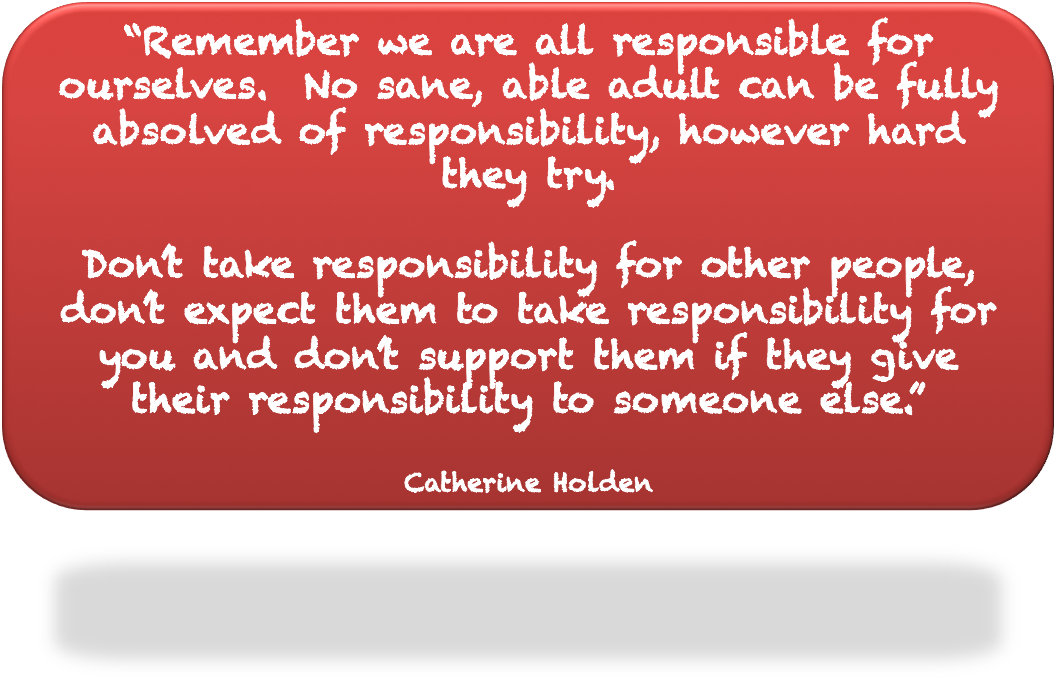
This is real victim territory.
Not victim of course in the sense of someone doing something to you that you don’t deserve or which is so unspeakably cruel it effects a serious, significant impact on your wellbeing.
But the victim mentality that encourages you to believe it’s always someone else’s fault, or that the change you want to see should come from them.
Well here’s my positive, panglossian (see my blog 07 Oct ’15), annoyingly optimistic view of that . . .
You, me, all those others . . . we each have a choice.
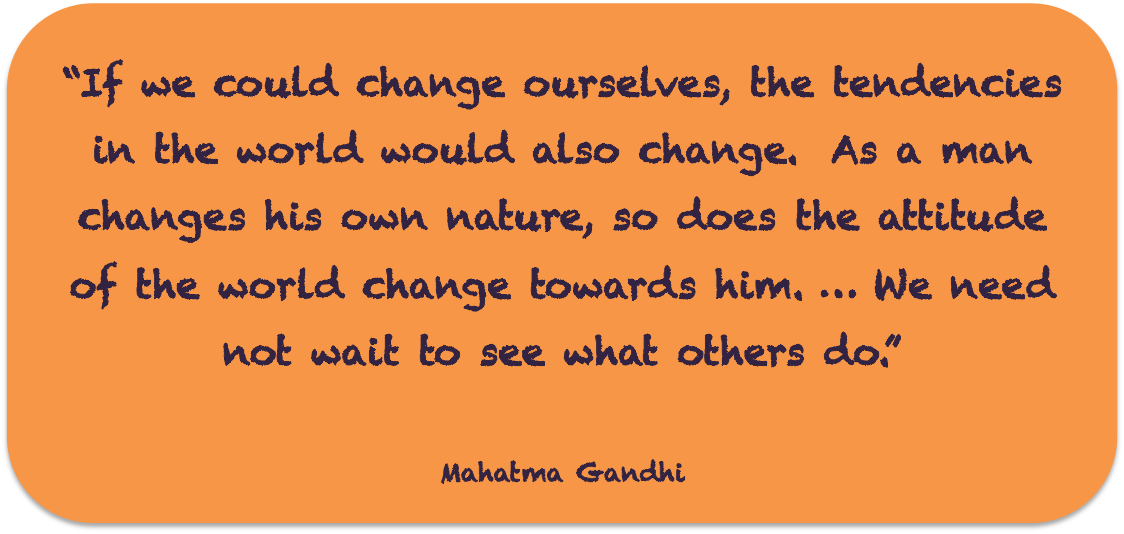
And the change you’re hoping for needs to start with you.
Ask yourself – is everything someone says or does really someone else’s fault? Might there just have been something you said or did that could have contributed to the problem/situation? As painful as it is to concede that this might be the case, I know that learning it to be true was a pivotal moment in my own development.
Picture the scene, circa 2004 . . .
Me to son: “Get upstairs and tidy up your room – now!”
Son, bordering on teenage years: “Yeh, OK, I’ll do it when The Simpsons has finished.”
So, obviously, this was in the days before one of the most wonderful pieces of technology ever invented had been released to the masses: the television pause facility. And in those days, quite honestly, I struggled with my son’s inability to be able to respond to my requests when I made them.
Feeling I could manage this frustration no more, I shared it with my very best friend . . . also the mother of a son the same age . . . and we went to the library (yes, it was that long ago) and sought solace from Dr Christopher Green’s very welcome tomes on parenting.
And the best thing I learned, and remembered?
-
Well, did that room need tidying exactly during the best episode of The Simpsons ever? Could I have waited until it had finished?
-
Was I contributing to the problem?
-
Could I have managed it better?
It all seems a little obvious, and more than a little embarrassing now . . . but hey, you don’t get to be an experiential learner without a lot of experience (OK, I’m a slow learner).
When I began to understand that my son’s ability to change was either going to be a long haul, or at the least a slow, slow process, I began to realise that the change had to start with me.
Yes, I could feel a range of emotions when it felt like he didn’t seem to care – anger, frustration, disbelief – I also learnt that I had a choice about how I dealt with him. And these emotions, every time, took me straight into victim mode:
-
He’s doing that just to annoy me
-
Why, just once, can’t he do it the first time I ask him?
-
Why is life so difficult for me?
But my little bit of enlightenment from Dr Green shone the spotlight on me. The change I was wanting needed to start with me. And that change required that I jolt myself out of victim mode with more than a gentle nudge.
It’s a lesson I’ve carried with me ever since, and one I try to remember when I feel myself inching at any time into that victim mode arena.
Yes, life is frequently hard, and sometimes so unbelievably challenging to the point when inside we’re begging, just give me a break . . . but empowering myself to believe that change needs to start with me, and that it’s actually quite rare for the whole world to be against me, was life-changing.

 ChristineWilkinsonCoaching
I love this! We all have a choice and when we give that control we are putting ourselves in vulnerable position and not taking responsibility for our actions. I always tell my parents you have to pick your battles. Examine your thought process and any cognitive distortion that might be occurring! Thanks!
LikeLike